How Off-Plan Property Developers in Dubai Use 3D Rendering to Increase Property Sales
In today’s competitive real estate and architecture market, high-quality architectural visualization plays a crucial role in attracting clients, investors, and buyers. However, not all 3D renders achieve the same level of realism. Many visualizations look obviously computer-generated, reducing their effectiveness and impact.
Professional architectural rendering is not just about creating a beautiful image. It is about creating a believable environment that feels as close to reality as possible.
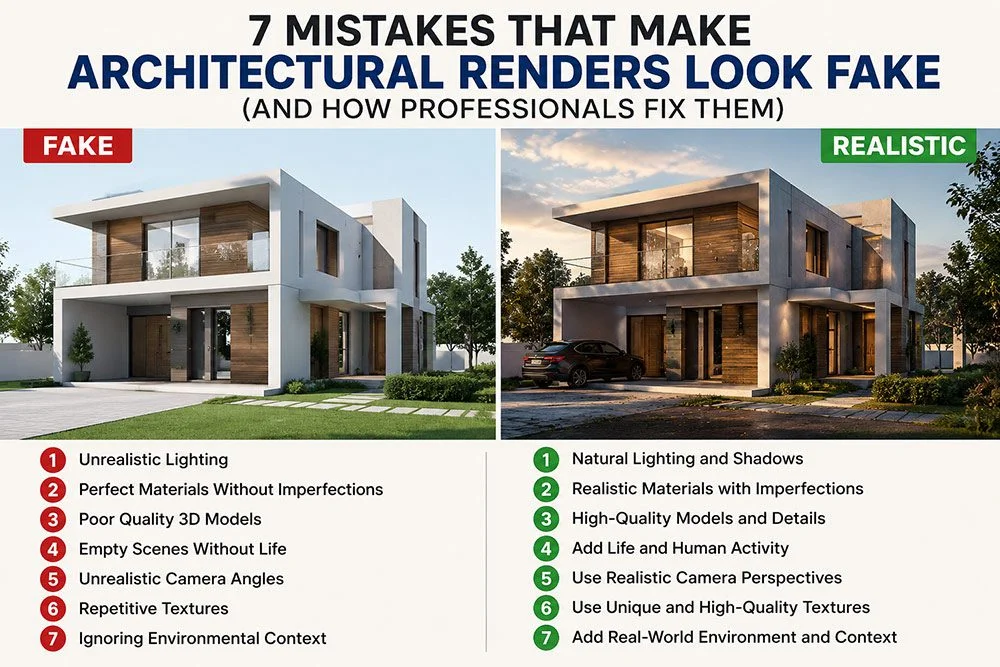
Here are seven common mistakes that make architectural renders look fake and how professional visualization artists fix them.
1. Unrealistic Lighting
Lighting is one of the biggest factors affecting realism.
Many beginners use overly bright sunlight, excessive contrast, or unrealistic artificial lighting. The result is an image that looks more like a video game than a real photograph.
Common Problems
- Overexposed windows
- Harsh shadows
- Excessive glow effects
- Uniform lighting throughout the scene
Professional Solution
Professional artists study real-world photography and architectural lighting. They carefully balance sunlight, skylight, interior lighting, and exposure settings to achieve natural results.
For example, luxury villa renderings in Dubai often use warm early morning or late afternoon sunlight to create depth and atmosphere.
Pro Tip
Observe professional architectural photography and try to replicate real camera exposure rather than creating artificial brightness.

2. Perfect Materials Without Imperfections
Real-world materials are never perfect.
Many renders fail because surfaces appear too clean and flawless.
Common Problems
- Perfect glossy floors
- Spotless glass
- Uniform concrete textures
- Plastic-looking furniture
Professional Solution
Photorealistic architectural rendering includes subtle imperfections such as:
- Dust
- Scratches
- Surface variation
- Fingerprints on glass
- Slight texture irregularities
These details may seem minor, but they significantly increase realism.
Example
Natural stone facades in Dubai often contain slight color variation and texture inconsistencies that should be visible in the final rendering.
3. Poor Quality 3D Models
Even the best lighting cannot save low-quality models.
Many artists use generic furniture or low-polygon assets that lack realistic detail.
Common Problems
- Simplified furniture
- Low-detail vegetation
- Poorly modeled accessories
- Unrealistic proportions
Professional Solution
Professional visualization studios invest in premium 3D assets and carefully select furniture, vegetation, lighting fixtures, and accessories that match the project’s quality level.
High-end residential projects require high-quality furniture 3d models, fabrics, decorative elements, and landscaping assets.

4. Empty Scenes Without Life
A perfectly rendered building can still look artificial if it lacks human activity.
Common Problems
- Empty streets
- No pedestrians
- No vehicles
- No activity around buildings
Professional Solution
Architectural visualization becomes more believable when it includes realistic context.
Professionals add:
- Walking people
- Parked cars
- Cyclists
- Outdoor seating
- Landscaping activity
These elements help viewers imagine how the space will actually be used.
Example
A waterfront development in Dubai feels much more realistic when people are walking along promenades, sitting in cafes, and enjoying outdoor spaces.
5. Unrealistic Camera Angles
Many renders are created from impossible viewpoints.
If the camera position does not feel natural, viewers immediately recognize the image as computer-generated.
Common Problems
- Extremely wide lenses
- Cameras placed too high
- Distorted perspectives
- Unrealistic field of view
Professional Solution
Professional artists use photography principles when positioning cameras.
Typical architectural photography uses:
- Human eye-level viewpoints
- Realistic focal lengths
- Balanced composition
- Natural perspective
This creates images that resemble real photographs rather than digital illustrations.


6. Repetitive Textures
Texture repetition is one of the easiest ways to identify a fake render.
Common Problems
- Repeating paving patterns
- Identical grass patches
- Duplicate plants
- Visible texture tiling
Professional Solution
Visualization professionals use:
- Large texture maps
- Texture variation
- Randomization techniques
- Multiple vegetation assets
This prevents viewers from noticing repeating patterns.
Example
Landscape rendering in Dubai often includes a mixture of trees, shrubs, ground cover, and hardscape materials to create natural diversity.

7. Ignoring Environmental Context
Many renders focus only on the building and ignore the surrounding environment.
Common Problems
- Floating buildings
- Empty backgrounds
- Unrealistic skies
- Missing neighboring structures
Professional Solution
A photorealistic render should place the project within a believable environment.
This includes:
- Neighboring buildings
- Roads
- Sidewalks
- Landscaping
- Street furniture
- Realistic weather conditions
Environmental context helps viewers understand how the project fits into its surroundings.
How Professional Architectural Visualization Studios Create Realistic Renders
Achieving photorealism requires a combination of:
Advanced Lighting Techniques
Natural daylight simulation and accurate exposure control.
Premium Materials
High-resolution textures and physically accurate materials.
Professional Composition
Architectural photography principles and realistic camera settings.
Detailed Landscaping
Natural vegetation placement and environmental storytelling.
High-End Post Production
Color correction, atmospheric effects, and realistic image enhancement.
Why Photorealistic Rendering Matters for Real Estate Marketing
High-quality architectural visualization helps:
- Attract investors
- Increase buyer confidence
- Improve project presentations
- Support planning approvals
- Enhance marketing campaigns
- Generate more property inquiries
In a competitive market such as Dubai, photorealistic rendering can significantly influence how potential buyers perceive a project before construction begins.
Conclusion
Creating realistic architectural renders requires much more than simply modeling a building and adding materials. Lighting, textures, camera composition, environmental context, and attention to detail all contribute to the final result.
By avoiding these seven common mistakes, architects, developers, and visualization artists can create compelling images that communicate design intent and help projects stand out in a crowded marketplace.
At Dubai3DMax, we specialize in photorealistic architectural rendering, interior visualization, exterior rendering, and 3D walkthrough animation services for projects across Dubai, Abu Dhabi, Sharjah, Saudi Arabia, Qatar, Kuwait, and the GCC region.